





Society is increasingly following a digital-first strategy, working against the clock to migrate physical circulation into digital circulation, hoping to slow down the COVID-19 pandemic growth curve. The digerati (Amazon, Google, Apple, Facebook, Microsoft, Alibaba, Tencent, Baidu, et al) are becoming an even more important component in this effort.
COVID-19 forced us to investigate more deeply how humans behave digitally when fulfilling basic needs such as health, infotainment, education, safety, and more. Government, Enterprises and people, in general, must acknowledge what we call “the dissonance of digital human needs” (Figure 1). Considering how humans behave digitally now—and how they might in the future—will help executives unlock new ways of thinking and spark innovation.
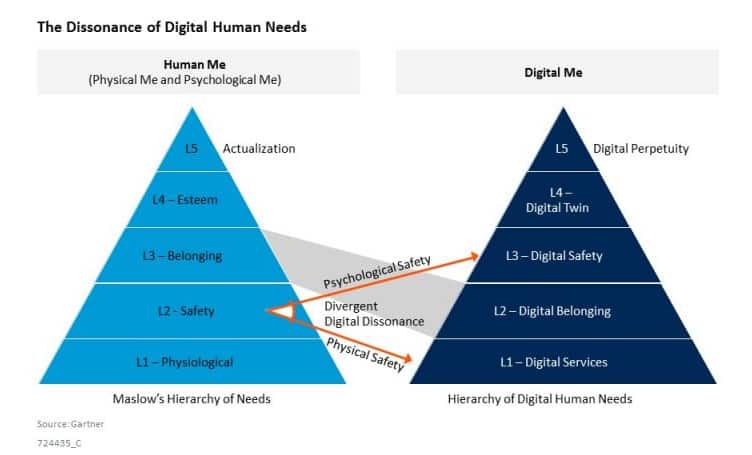
Figure 1: The Dissonance of Digital Human Needs – Source Gartner 2020
In the last decade, people have used the internet and various services (social networks, texting, dating sites, infotainment, email, et al) to experiment and elevate themselves to a global sense of belonging, often overlooking the fact that we live in specific regions, countries, and locales. This has enabled the digerati to dramatically increase their influence across global societies.
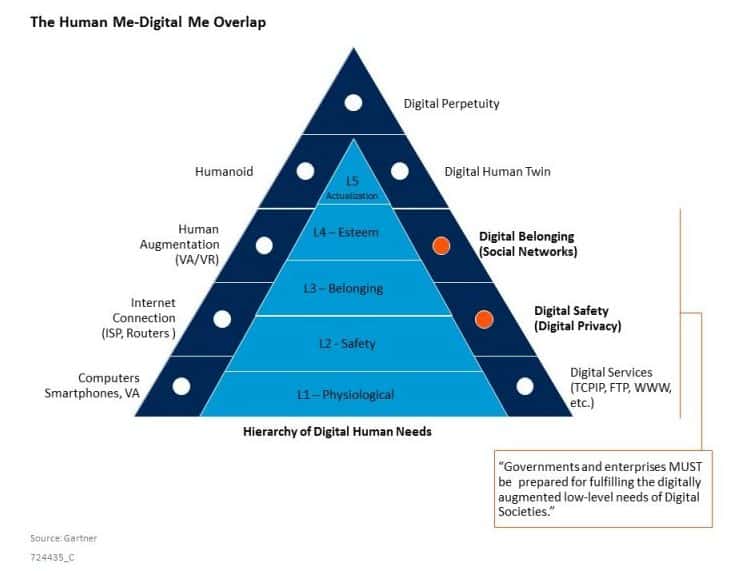
This result is a transition from “human me” to a rapidly evolving “digital me” that exists in a virtual world of the internet, clouds, computers, mobile phones, software, infotainment, social networks, email, and more). Each “me” has distinct but related hierarchies of need, as Figure 1 illustrates. Digital Me is evolving largely due to the Physical/Psychological Me’s need for belonging (L3 on Maslow’s hierarchy of human needs in Figure 1). Digital technologies have expanded exponentially the ability to connect people continuously, regardless of physical and geographical boundaries.
Only after fulfilling our need for digital belonging and the “techno-convenience” of procuring many of our physical needs online will we consider things such as digital safety (including privacy). But this is motivated by a basic instinct to achieve “belonging” (and perhaps even perpetuity) through Digital Me, without physical constraints, adding a new, tangential dimension to Maslow’s hierarchy.
Digital dissonance results from the illusion of being able to decouple physical constraints. The misalignment of safety needs between Physical/Psychological Me and Digital Me enables individuals, enterprises and governments to gain ever greater socioeconomic, physical and psychological influence (and control) globally.
The COVID-19 pandemic is making humans more aware of the intimate relationship between higher-level needs—especially belonging—and the most basic needs required for survival. Innovative ideas suitable for the “never normal” will evolve by being conscious that the Digital Me is expressed primarily through the psychological need for belonging, now facilitated by almost unlimited frictionless global connections.
So, where’s the downside? While governments recognize and even nurture humans’ need to be part of an increasingly complex society, many are beginning to realize that digital service providers are gaining power. They are doing so not only by meeting digital needs but by increasingly controlling (directly or indirectly) and provisioning many basic needs, like food, healthcare, education, shelter, clothing, infotainment, and possibly even safety and energy.
When it comes to innovating, governments and traditional enterprises have what we call a “linearity bias” or constraint when structuring ideas for solving digital society problems or even defining their own digital strategies. We call this the “digital ideation dissonance” (Figure 2).
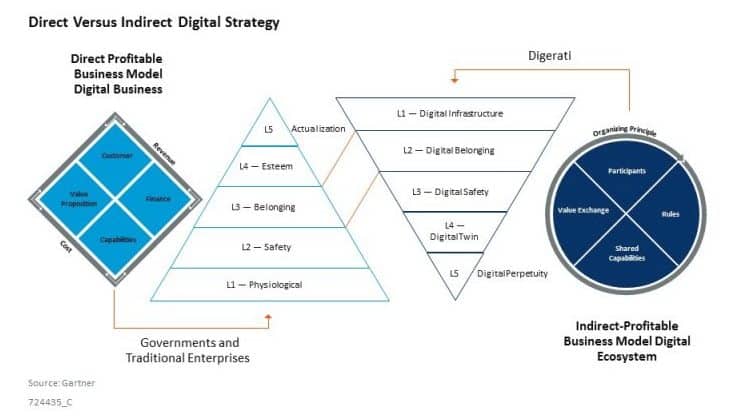
Figure 2 The Digital Ideation Dissonance- Source Gartner 2020
For example, enterprises and governments often view technology as just another tool for adding to their existing value chains. They also consider the transformational potential of digital technologies as components of profitable business models (enterprises) or GDP growth (governments). By fulfilling human needs through the digital me, however, digerati innovate in a non-linear way by enabling digital ecosystems that facilitate indirect profitable opportunities.
COVID-19 is demonstrating the urgent need to break the linear versus the non-linear way of thinking. Digital is not the solution for all pandemic issues, and it can actually create new vulnerabilities.
This is not about “market share” or “Digital Me share”. This is about the human race and its evolution to achieve consonance by aligning the “Human Needs” with the “Digital Me” for achieving perpetuity in a sustainable way (Figure 3).
If we fast-forward through the COVID-19 crisis, and prepare for the next crisis, we must think about innovation in a way that transcends linear constraints—something that digital technology makes possible. Finding ways to collaborate effectively with the digerati to serve burgeoning business and society needs (especially for data collection, stewardship and analytics) will become a critical path.
This is an excerpt of the Maverick Research: “The Digerati Are Becoming Part of 21st Century Societies’ Infrastructure Services” and used as a foundational concept of an ideation framework used in a new report titled “The Never Normal,” produced under the direction of Dr. Omar Hatamleh. More than 70 enterprises throughout government (including NASA), academia, nongovernmental organizations and the private sector contributed to this report, which you can download from the Project Cross Innovation website, crossinnovation.org. First published on Gartner Blog Network