


Gartner describes communications service provider (CSP) as offering telecommunications services or some combination of information and media services, content, entertainment and application services over networks, leveraging the network infrastructure as a rich, functional platform.
In plain English, a CSP is the company that allows me to make calls, send and receive messages to others, and they allow us to consume content on a content delivery device like a smartphone or a computer.
Just to be clear, a CSP may not necessarily be the over the top (OTT) provider – these are businesses that deliver service using the infrastructure operated by a CSP.

FutureCIO spoke to Luis Rezende, vice president of Insight at Niometrics to talk about the value of data as viewed from the perspective of a CSP.
Land of Plenty
Every industry creates data. For the health industry that could be the patient records. For banks, that is customer data and the transactions they make with the bank. For a CSP the data profile has changed in 1992.
Before 1992 CSPs had two types of data. One is customer and customer billing data. The second data is calling information which they use to help make pricing plans.
The arrival of the smartphone in 1992 expanded the type of data coursing through the CSP’s network. Using their smart devices, subscribers started consuming a variety of content – voice, video and data – for personal and work.
Source: IDC, Niometrics
Rezende said CSPs can still use that information to understand their customers, design better services, design better bundles. “They could also now sell this intelligence to help other businesses sell products or services, and for governments to better understand consumer behaviour,” he added.
And for awhile, this intelligence became a wellspring of new revenue and everything was good.
What started as a unique advantage didn’t stay exclusive to CSPs because eventually over-the-top media services (OTTs), that use the CSPs network have learned how to capture this same intelligence, maybe even more efficiently (or smarter).
“Everyone is running in the same direction. It is a cut-throat competition and one in which CSPs haven’t done that well at. Other players, more native digital players, that started out in the end of the first decade of the millennium, they have typically done a better job at using data in smart ways and capturing value with it,” said Rezende.
CSPs soon found themselves having to consider looking for new revenue opportunities, again.
Privacy vs Insight
At the same time, both CSPs and OTTs were discovering that customers have become conscious of the value of their personal data, including what they consumed. Privacy became a tangible concern for both consumers and a cause for concern for CSPs and OTTs (and basically any business that uses data).
Rezende suggested putting into place safeguards and mechanisms and the right engineering to make sure that “you can still have all that knowledge and produce all those insights without having to jeopardize individual liberties.”
He spoke of an emerging field in computer science called privacy engineering that is trying to do exactly that.
“Privacy engineering focuses on developing techniques, algorithms, software code that give companies the ability to still produce intelligence on whatever would be useful to have the intelligence on, without having to risk exposing individuals or groups of people,” he explained.
Owning the data
Rezende acknowledges that data warehouses have been around for decades. Primarily designed for structured data formats, these have since lessened their values as data volumes grew and data types expanded.
There was anticipation that Hadoop would step in where data warehouses could not.
“But that didn’t happen – just putting a lot of data from different sources into one big data lake doesn’t magically create insights, and even after it creates insights, it doesn’t magically help those insights to be actionable,” he opined.
He believed that the bigger mistake was to keep governing all that data in a way that follows the same organizational siloes they have.
It is very complicated to do data integration because data ownership is very unclear within the CSP organizations, he commented. He added that CSPs don’t have an integrated, end-to-end stack when it comes to data systems, otherwise things would get much easier.
“So, overall integration, the mindset of how data should be managed, reflected in systems that deliver end-to-end data management, is something that CSPs don’t have and it holds them back big time. It’s one of the big things that the big digital players do have – they just treat data horizontally across their organizations – like Google, Facebook,” explained Rezende.
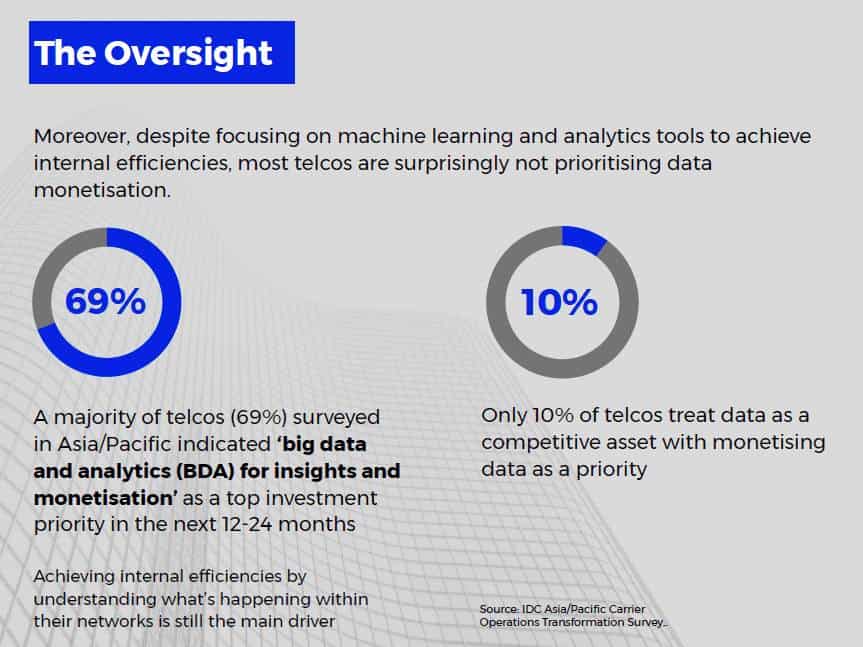
Monetizing data

Source: IDC, Niometrics
When asked how CSPs monetize data, Rezende disclosed that there are several approaches taken by CSPs.
The first category of data monetization is using the data and intelligence gathered from it to improve own services. “The goal is to have better offerings, to have more efficiency in how you manage your network; essentially just looking at making your own business better,” said Rezende.
The second is using that data to create new products, typically in partnerships with other companies. For instance, a CSP could partner with a bank whereby the former would sell information about who could potentially be a good payer based on their digital behaviour.
For Rezende the more innovative approach comes from using data management platforms – one where individual data is hidden, to comply with privacy, and create an open platform from which intelligence can be harvested from this anonymised data.
“We have clients in Southeast Asia who are already in the process of producing the intelligence that’s going to go into systems that can be accessed by other companies on the fly. These could be advertising networks on the fly or governments for example. This is a more innovative, visionary way of monetizing data, in which you open up a platform for other players to consume data from your ecosystem,” he elaborated.
Leading the charge to data monetization
Drawing from conversations with customers around the region, Rezende suggested setting up a centre of excellence that gets the mission of orchestrating everyone around a data monetization strategy and then trying to cut across siloes – both organizational and system siloes – to have some use cases gain traction.
He warned that this is very complicated to do inside a CSP because they’re just not designed to work with this type of transversal coordination.
He suggested the CEO set up a team with strategic and the organizational empowerment to push this agenda.
“If these people don’t come with this empowerment, they almost always get drowned under all of the other millions of day-to-day operational issues that CSPs have to deal with. It really has to come from the top with a clear mandate, to innovate on that front,” he concluded.


