






The average worker checks their email 36 times an hour and takes 16 minutes to refocus after handling a new email. During an average workday, a single minute might seem negligible. But if you take a step back and compound that on a global level, approximately 188 million emails are being sent – every minute.
With that volume of data continuing to grow at a blistering pace, imagine a scenario when your co-workers are losing two hours of productivity per day simply because they couldn’t locate the information they need to fulfil their tasks?
While this is not a new challenge, it is a real issue that businesses continue to struggle with, especially in the face of surmounting threats that aim to expose data for gain. IDC predicts that the collective sum of the world’s data will grow from 33 zettabytes this year to a staggering 175 zettabytes by 2025.
The risk this poses is of no small measure – left uncontained, this data deluge could very well morph into a beast of its own.
Managing data with data
Let’s talk about how the consequences of ineffective data management can be crippling regardless of organisation size. For example, it’s not unusual for an IT manager to receive a request from a customer to locate all instances of their personal data and delete it.
Sounds straightforward, doesn’t it? But this simple request can turn into a time-consuming nightmare and place the company at risk from lawsuits or expensive fines if the customer’s personal data goes missing.
Unknown to some, behind the glamour of powerful analytical insights is a backlog of tedious data preparation. A recent Value of Data study found that global organisations lose an estimated US$2 million a year due to an evil that can reduce ROI across all functions: data silos.
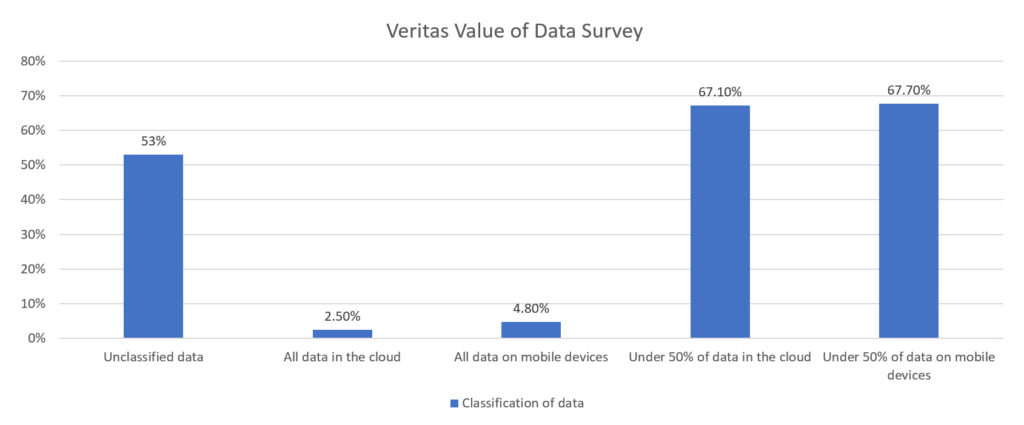
These silos are isolated islands of data, and they make it prohibitively costly to extract data and put it to efficient use. 53% of respondents from Singapore say that the data within their organisation remains unclassified or untagged.
Worsening the issue, public cloud and mobile environments represent the weakest links in data security. The Value of Data study also revealed how 67% of companies in Singapore admit they have classified less than half of their public cloud data, with the same proportion ringing true for mobile devices.
Notwithstanding the alarming statistics, it is only fair to acknowledge that the biggest challenge for many organisations in Singapore is understanding what data resides in their complex IT environments, how to protect the data and delete it from the network when requested or when it’s no longer needed.
Creating a data ecosystem
On the other hand, big data can create positive benefits and business opportunities. Putting aside data sovereignty and privacy issues, the deployment of technology for tracing apps and active data sharing in the current pandemic have helped to flatten the COVID-19 curve for some East Asia countries.
In other instances, big data will similarly lead to positive outcomes. For example, smartphone data captured in real-time can alert retailers that customers are comparing prices online for a specific product, or how the collection and analysis of traffic data can surface vehicle movement and road usage patterns over time for Smart Cities.
With the soaring volumes of data being created and stored every day, companies can consider following these guidelines to ensure that their organisation is kept in check:
- Classifying data
The critical first step for organisations is to build a data map of where data is being stored and having visibility into who has access to it, how long it is being retained, and where it is being moved.
- Enabling policies
The principles in data protection policies set the tone and provide guidance around an organisation’s treatment of personal data. Additionally, insights gleaned from data classification also demonstrates accountability to external parties by keeping them informed on the ways in which data is used.
- Automation
With every petabyte of enterprise data, there are roughly three billion files – beyond mankind’s capacity to manage it. Automation, through means of artificial intelligence and machine learning, can take on the tasks that an IT workforce cannot to improve operational efficiency.
To put things into perspective, consider a post-pandemic scenario where a local air carrier wants to invest in an AI algorithm to devise new routes that take into consideration the reduced capacity. In order to get a robust analysis, the local airline will require access to data sets from other regional countries such as Thailand and Australia.
Successful completion of the insights developed would require less-man hours, deliver more patterns than humans would, and cost less than conducting such an analysis manually – that’s the power of data.
In a nutshell: It will take a concerted effort by both employers and employees to adhere to industry best practices for classifying, storing and protecting data. Done right, IT leaders expect that investing in data management can produce an ROI of 2.16 for every dollar spent. Now that’s the beauty that resides within a beast.