





• About
  • Subscribe
  • Contact
Friday, March 20, 2026
    Login
  • Management Leadership
    • Growth Strategies
    • Finance
    • Operations
    • Sales and Marketing
    • Careers
  • Technology
    • Infrastructure and Platforms
    • Business Applications and Databases
    • Big Data, Analytics and Intelligence
    • Security
  • Industry Verticals
    • Finance and Insurance
    • Manufacturing
    • Logistics and Transportation
    • Retail and Wholesale
    • Hospitality and Tourism
    • Government and Public Services
    • Utilities
    • Media and Telecommunications
  • Resources
    • Whitepapers
    • PodChats
    • Videos
  • Events
No Result
View All Result
  • Management Leadership
    • Growth Strategies
    • Finance
    • Operations
    • Sales and Marketing
    • Careers
  • Technology
    • Infrastructure and Platforms
    • Business Applications and Databases
    • Big Data, Analytics and Intelligence
    • Security
  • Industry Verticals
    • Finance and Insurance
    • Manufacturing
    • Logistics and Transportation
    • Retail and Wholesale
    • Hospitality and Tourism
    • Government and Public Services
    • Utilities
    • Media and Telecommunications
  • Resources
    • Whitepapers
    • PodChats
    • Videos
  • Events
No Result
View All Result
No Result
View All Result
Home Management Leadership Careers HR, education and Training

Hybrid work models still far from employee experience parity

by FutureCIO Editors
September 24, 2021
Photo by Anthony Shkraba from Pexels

Photo by Anthony Shkraba from Pexels

The global pandemic forced IT teams and business leaders to dramatically rethink where and how their employees work.

With the post-pandemic recovery underway but challenged by the Delta variant and uneven vaccination rates, many organizations are still trying to determine what their future hybrid work model will look like. IDC says stability and geography will define the balance of future work strategies.

Preferred location for work

On a global basis, physical office sites are still expected to be the dominant location for work as organizations find themselves in a more stable and "steady-state" environment. However, the mix of office-based, remote, non-office, and field workers is expected to vary from region to region.

Asia/Pacific workers are more likely to claim the physical office space as a primary work location compared to the United States and Europe, the Middle East, and Africa (EMEA). In EMEA, 27% of respondents prefer remote or work-from-home as their primary work location. Meanwhile, the U.S. workforce currently working remote (44%) is expected to decline, but field and non-office locations are gaining favour as primary work locations.

"The ratio of support for hybrid work opportunities within and across geographies will no doubt continue to evolve. Work primarily within office facilities, while a dominant choice, will certainly be part of a hybrid mix that will flex to address new and unforeseen challenges to organizational, political, and social instability," said Holly Muscolino, research vice president, Content Strategies and Future of Work, IDC.

The quest for experience parity

Another aspect of these evolving hybrid work strategies is the effort to achieve "experience parity" – a comparable employee experience for a hybrid workforce by ensuring that all workers securely interact with corporate resources (including people) with a consistent experience and context across locations.
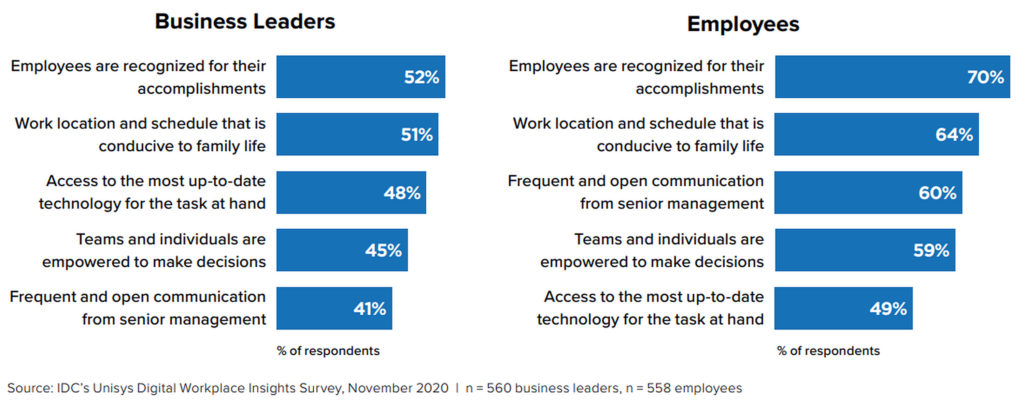
While experience parity has not yet been achieved by most organizations, nearly half the companies surveyed indicated that their hybrid work technologies, policies, and processes were "in progress" with most key resources available to remote employees with some lingering access or user experience issues.

Amy Loomis, research director for Future of Work says investment in digital and work transformation technologies align with organizational imperatives around improved business resilience and increased employee productivity.

"We are also tracking a direct correlation between spending levels with stronger momentum toward achieving experience parity for hybrid workers while lower spending levels align with more limited or ad hoc approaches," she concluded.

Related:  IDC sees growth opportunities in the services market for 2022
Tags: future of workhybrid work modelsIDC

FutureCIO Editors

No Result
View All Result

Recent Posts

  • Veeman unveils Agent Commander to control AI risks
  • AI slop, top threat to brand trust in APAC, research warns
  • UiPath and Deloitte unveil new agentic ERP offering
  • Organisations overlooking impact their websites have on sustainability
  • Alibaba Group unveils AI-native enterprise platform

Live Poll

Categories

  • AI and Machine Learning
  • Artificial Intelligence
  • Big Data, Analytics & Intelligence
  • Business Applications & Databases
  • Business-IT Alignment
  • Careers
  • Case Studies
  • CHRO
  • CISO
  • CISO strategies
  • Cloud, Platforms and Ecosystems
  • Cloud, Virtualization, Operating Environments and Middleware
  • Compliance and Governance
  • Compliance and Governance|Technology
  • Computer, Storage, Networks, Connectivity
  • Corporate Social Responsibility
  • Culture and Behaviour|People
  • Customer Experience / Engagement
  • Cyber risk management
  • Cyberattacks and data breaches
  • Cybersecurity careers
  • Cybersecurity operations
  • Data Protection
  • Digital Transformation
  • Education
  • Education
  • ESG and sustainability
  • Finance
  • Finance & Insurance
  • Future Workplace
  • FutureCISO
  • General
  • Governance, Risk and Compliance
  • Governance, Risk and Compliance
  • Governance, Standards and Regulations
  • Government and Public Services
  • Growth Strategies
  • Hospitality & Tourism
  • HR, education and Training
  • Industry Verticals
  • Infrastructure & Platforms
  • Insider threats
  • IT-OT integration
  • Latest Stories
  • Logistics & Transportation
  • Management Leadership
  • Manufacturing
  • Media and Telecommunications
  • News Stories
  • Operations
  • Opinion
  • Opinions
  • People
  • Process
  • Remote work
  • Retail & Wholesale
  • Sales & Marketing
  • Security
  • Sustainability
  • Tactics and Strategies
  • Technology
  • Utilities
  • Videos
  • Vulnerabilities and threats
  • White Papers

Strategic Insights for Chief Information Officers

FutureCIO is about enabling the CIO, his team, the leadership and the enterprise through shared expertise, know-how and experience - through a community of shared interests and goals. It is also about discovering unknown best practices that will help realize new business models.

Quick Links

  • Videos
  • Resources
  • Subscribe
  • Contact

Cxociety Media Brands

  • FutureIoT
  • FutureCFO
  • FutureCIO

Categories

  • Privacy Policy
  • Terms of Use
  • Cookie Policy

Copyright © 2022 Cxociety Pte Ltd | Designed by Pixl

Login to your account below

or

[wpli_login_link]

Not a member yet? Register here

Forgotten Password?

Fill the forms bellow to register

All fields are required. Log In

Retrieve your password

Please enter your username or email address to reset your password.

Log In
No Result
View All Result
  • Management Leadership
    • Growth Strategies
    • Finance
    • Operations
    • Sales and Marketing
    • Careers
  • Technology
    • Infrastructure and Platforms
    • Business Applications and Databases
    • Big Data, Analytics and Intelligence
    • Security
  • Industry Verticals
    • Finance and Insurance
    • Manufacturing
    • Logistics and Transportation
    • Retail and Wholesale
    • Hospitality and Tourism
    • Government and Public Services
    • Utilities
    • Media and Telecommunications
  • Resources
    • Whitepapers
    • PodChats
    • Videos
  • Events
Login

Copyright © 2022 Cxociety Pte Ltd | Designed by Pixl

Subscribe