


The scurry to adopt artificial intelligence (AI) is creating not only potential gaps in organisations, but also likely to result in yet another global digital divide.
The discovery of single-purpose and general-purpose tools have driven major industrial revolutions, including electricity and digital computing. The next significant general-purpose technology to impact global economies, undoubtedly, would be AI, said Brad Smith, Microsoft’s vice chair and president, who was speaking at ATxInspire fireside chat, hosted by Singapore’s Infocomm Media Development Authority.
At the same time, however, it is creating a new gap and global divide, Smith said, citing Microsoft’s AI Diffusion report.
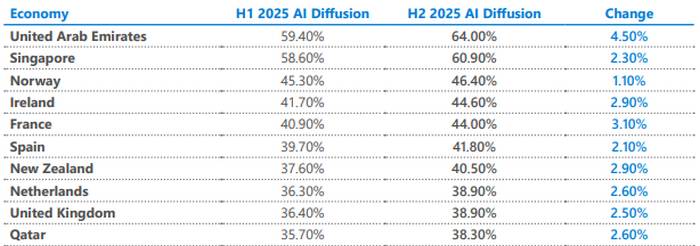
Source: Microsoft AI Economy Institute
Produced by the Microsoft AI Economy Institute, the study based its AI diffusion measurement by looking at adoption of GenAI across countries that “best advance priorities”, including scientific discovery and productivity gains. It analysed more than 1 billion Windows devices, taking into consideration third-party data on Windows’ market share to adjust for the exclusion of data from non-Windows devices. Data also was adjusted to reflect differences in internet penetration and country population.
Singapore ranked second in the index, after the United Arab Emirates (UAE), with 60.9% of its working age population using AI as of end-2025, compared to 64% in the UAE. Norway, Ireland, and France, rounded up the top five nations on the AI diffusion index.

Worldwide, adoption of GenAI tools hit 16.3%, with one in six using AI to learn, work, or solve problems, the report noted.
Critical role of infrastructure, skilling
However, adoption amongst countries in the Global North climbed almost twice as fast as populations in the Global South, with the gap clocking at 10.6%.
Some 24.7% across working age populations in the Global North used GenAI tools as of end-2025, compared to 14.1% of their peers in the Global South.
Smith underscored the importance of building the necessary infrastructure and skills to drive AI adoption within societies, noting that these were the two primary challenges facing global economies.
Amongst the top 30 nations in AI Diffusion index, those that invested early and consistently in digital infrastructure continued to lead, he said.
Smith pointed to markets and regions such as Japan, Korea, Singapore, and Europe, where infrastructures were built more quickly and AI adoption were comparatively high.
Skillsets, too, are critical to ensure nations are able to further drive and facilitate AI deployments, he said.
Adopting AI despite concerns
As it is, potential gaps are emerging as enterprises feel the urgency to deploy a technology that still is rapidly advancing and evolving, even if rushing to do so comes with risks.
A new study from Trend Micro’s TrendAI found that 67% of business and IT business decision makers felt pressured to approve AI despite security concerns. One in seven described such concerns as “extreme”, but suppressed them to keep pace with competitors and internal demand, the report found.
A further 57% said AI was advancing more quickly than they could secure it, while 64% expressed moderate confidence in their understanding of legal frameworks governing AI, revealed the study, which polled 3,700 respondents worldwide.
Just 38% had comprehensive AI policies in place, with 41% pointing to unclear regulatory or compliance standards as barriers.
On agentic AI, while 44% pointed to agents accessing sensitive data as their biggest risk. Another 33% were concerned about abuse of trusted AI status and risks associated with autonomous code deployment.
Some 31% revealed that they lacked observability or auditability over AI agents.
“Organisations are not lacking awareness of risks, they’re lacking the conditions to manage it,” said Rachel Jin, chief platform and business officer and head of TrendAI. “When deployment is driven by competitive pressure rather than governance maturity, you create a situation where AI is embedded into critical systems without the controls needed to manage it safely.”
“Without visibility and control, organisations are deploying systems they don't fully understand or govern, and that risk is only going to increase unless action is taken," Jin said.
According to the study, 40% backed the need for an AI kill switch, enabling systems to be shut down in the event of a failure or misuse. Almost half of the respondents, though, were unsure if this was necessary.
Free access to Copilot
In its efforts to address the lack of skills and guidance to adopt AI effectively, Microsoft said it is providing free access to its Copilot tools via its Elevate programme.
During his visit to Singapore, Smith said the software vendor was on track to spend US$5.5 billion on cloud and AI infrastructures as well as operations in the city-state over five years, from 2025 through to 2029.
Part of this investment here will now include providing all tertiary education students with one-year free access to Microsoft 365 Premium with Copilot and its productivity software suite. There are currently more than 200,000 students enrolled in local universities and vocational training institutions.
Educators also will be offered free AI training through the Microsoft Elevate for Educators programme, while non-profit business leads will be upskilled with AI under its Elevate for Changemakers scheme, the vendor said.