
In 2021, at the Sixth Annual Gartner Chief Data Officer Survey, respondents who successfully increased data sharing "led D&A [data & analytics] teams that were 1.7 times more effective at showing demonstrable, verifiable value to D&A stakeholders."
Fast-forward five years, and as Asia's financial institutions navigate explosive digital growth and intensifying competition, internal data marketplaces stand out as a strategic imperative for forward-thinking CIOs.
Defined by IBM as secure online platforms that connect data providers and consumers for sharing and collaboration, these marketplaces are gaining relevance. With over two-thirds of APAC institutions already leveraging AI—and adoption continuing to climb for analytics, fraud detection, compliance, and personalised services—contextualised internal data marketplaces are essential enablers.
They democratise high-quality, governed data, break silos, and unlock monetisation while addressing regulatory complexity from data localisation in China, India, Singapore, Thailand, and Malaysia.
Amid emerging harmonised frameworks like the ASEAN Digital Economy Framework Agreement (DEFA, targeted for signing in 2026) to enable trusted cross-border flows, well-contextualised marketplaces provide a compliant foundation for ethical AI innovation, superior decision-making, financial inclusion for underserved segments, and sustained competitive advantage.
In this dynamic landscape, CIOs who prioritise rich context—metadata, lineage, and business relevance—will transform regulatory challenges into opportunities for scalable, AI-driven value creation.
Breaking silos with self-service trusted data

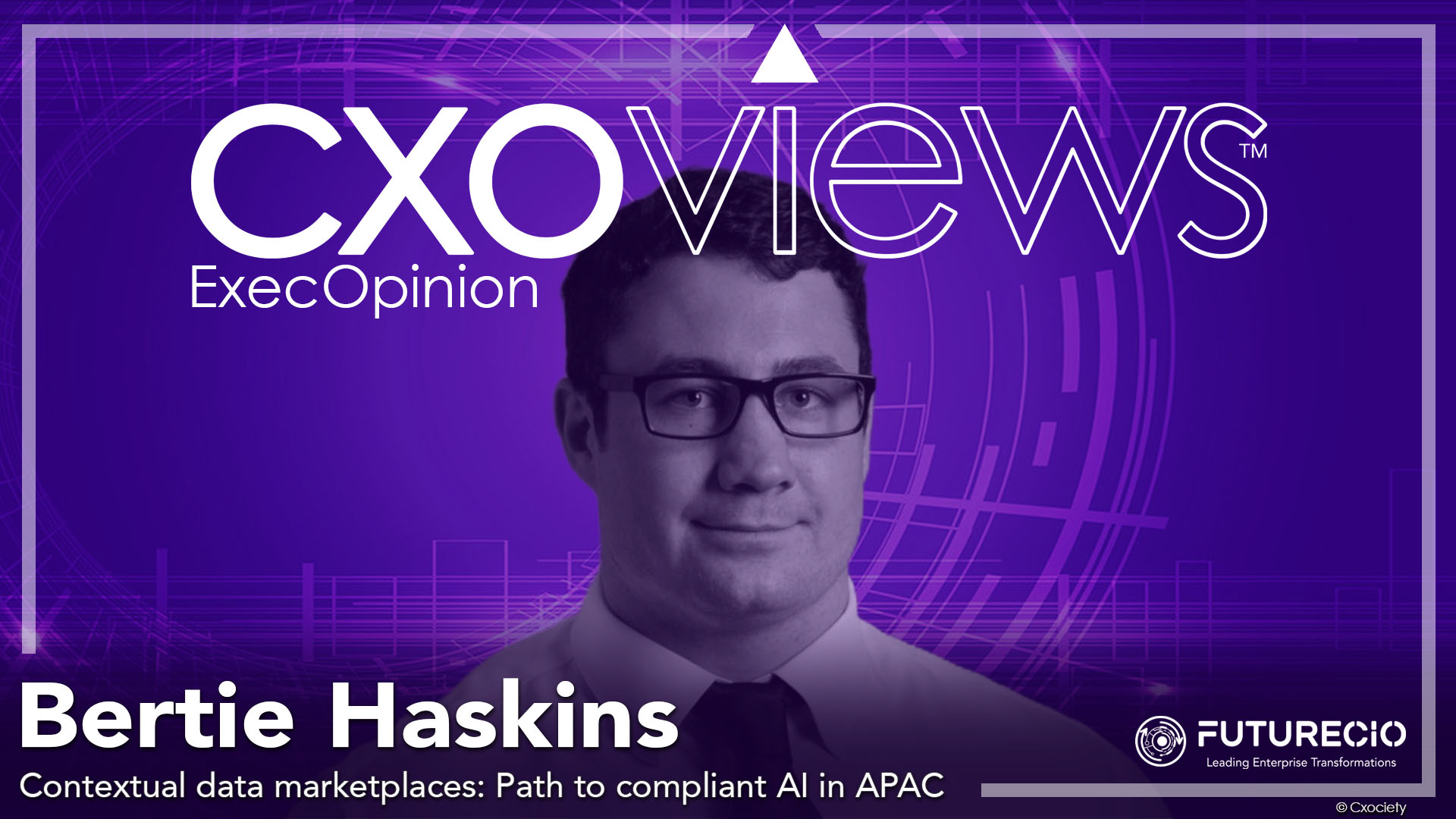
Bertie Haskins, executive director and head of Data for APAC and Middle East at Capco, emphasises that many organisations have invested heavily in data governance, management platforms, AI, and analytics—yet these capabilities remain fragmented.
"If you look at some of those organisations... there's been multiple investments in data so data governance, data management platforms, AI and analytics, but what you'll find is, in the number of organisations, those capabilities are siloed and fragmented," he explains.
Internal data marketplaces solve this by creating a single self-service portal focused on the data user's experience. Internal stakeholders—from retail banking to investment banking and risk functions—can discover, interrogate, and access trusted data at scale without external provisioning.
Haskins posits three pillars underpinning success: effortless discovery and access, robust trust and quality scoring with full context, and tightly controlled provisioning workflows. The result is a secure, internal capability that turns data assets into readily consumable products while preserving privacy and security.
As Haskins notes, "what marketplaces do is bring this all together, but it's really focused on the experience of the data user... creating a self-service portal that provides trusted data at scale."
Navigating APAC's regulatory maze for cross-border operations
Regulations on data localisation and privacy in China and India are evolving rapidly, creating overwhelming complexity for multi-market institutions.
Haskins observes: "When you look at Asia, the complexities of the multiple markets, multiple regulations... the complexity is overwhelming in some cases. Regulations are evolving fast, but so is the requirement for data, which is only increasing with AI."
The solution lies in foundational data governance and management embedded by design into the marketplace. Privacy, localisation, and quality become intrinsic—either through modular links to existing capabilities or as native platform features.
This "built-in" approach creates scalable, trusted data assets that comply by default, allowing CIOs to support cross-border operations without constant firefighting.
Marketplaces as compliance enablers
For regional financial services institutions (FSIs), internal data marketplaces have become indispensable for balancing monetisation with obligations to the Monetary Authority of Singapore (MAS) and the Hong Kong Monetary Authority (HKMA).
Haskins groups these obligations into four buckets: data governance and management; AI risk management and explainability; technology resilience, risk, and cyber security; and data protection with localisation.
Marketplaces address all four through embedded metadata that documents source, ownership, controls, and usage rights. Controlled provisioning workflows ensure data reaches only authorised domains, while contextual metadata answers critical questions before any access is granted—turning compliance from a burden into a competitive advantage.
Haskins highlights: "The way in which marketplaces sort of enable that is that embedded data management... all of that contextual metadata is very important."
Rich context builds unbreakable trust
Providing rich context is not about perfection but transparency. Users need to know the authoritative source, transformation history, fitness for purpose, and trust scoring of every data product.
"Providing rich context enables trust of data... you need to ensure it's transparent about the trust-level scoring... some key questions users might ask are: where does my data come from? What's an authoritative data source? What's happened to the data on that life cycle?" Bertie Haskins
In large organisations spanning multiple markets, this context determines whether data can legally or ethically be used in a specific jurisdiction or use case. Far from a "big bang" exercise, context is built incrementally around live business needs.
The payoff is profound: users gain confidence, adoption soars, and the organisation avoids costly misinterpretation of data meaning.
Overcoming siloed data risks
To make context the true differentiator, CIOs must engage business users from day one.
Haskins advises: "The most important thing here is engaging the business early and bringing together the business user and the metadata and the underlying data. You want to be creating data sets or data products for specific use cases and business goals."
This approach eliminates the classic data-lake paradox—"we have the data, but who can use it and is it any good?"—replacing silos with an intuitive, governed experience that dramatically improves decision accuracy and reduces the risk of misinterpreted or outdated data.
Incremental paths to marketplace maturity
Before building, CIOs must evaluate existing capabilities rather than chase an abstract notion of "data maturity."
Haskins clarifies: "It is not necessarily around data maturity... this doesn't need to be a big bang. There should be modular and incremental... the starting point would be, what existing capabilities do I have?"
Prioritisation aligns with organisational strategy: heavily regulated banks may first strengthen data quality and lineage, while more mature organisations focus on analytics-ready products.
The key is a modular, business-unit-driven roadmap with continuous user feedback—ensuring the marketplace evolves organically.
Automating compliance for 2026 demands
Haskins views privacy through three lenses: strategy and process, data requirements with supporting metadata, and enabling technology.
Privacy-by-design in the marketplace automates discovery and classification of sensitive data, auto-quarantines new items for human review, reuses prior privacy assessments, enforces retention and deletion rules, and manages consent at scale.
These metadata-driven automations ensure decisions about access, usage, and sharing occur instantly and comply with regulations—critical as 2026 brings tighter AI-specific regulations across APAC.
Scaling marketplaces for measurable ROI
Common traps include unclear success metrics, ambiguous data ownership, siloed development, and overly rigid controls that stifle adoption.
Haskins urges: "The first mistake... is really being clear and setting goals up front, around what's the purpose of the marketplace and how we're going to measure success."
Build modularly so capabilities can be added or adjusted as regulations and needs evolve. Balance ease of publishing with robust controls; in the age of agentic AI, users must explore data without ever touching private or restricted assets.
ROI becomes visible through higher adoption, faster AI deployment, and reduced compliance costs.
Contextual data as a foundation
Well-contextualised marketplaces serve both humans and AI models. Accurate metadata on source, ownership, privacy tags, localisation constraints, and quality profiling ensures generative AI in fraud detection or customer analytics operates on reliable, jurisdiction-appropriate data.
"When you look at data marketplaces, they provide data for consumption to humans but also AI and models. So, ensuring the context of that data is accurate... is very important." Bernie Haskins
Mitigating bias and accelerating inclusive innovation
Haskins highlights that clear data context dramatically improves AI explainability and traceability: "ensuring that both foundational capabilities and control in place are incredibly important... You can improve the explainability for the models and how they get to an answer."
CIOs can audit lineage, test improvements iteratively, and mitigate bias while opening innovation in underserved segments—such as rural customers in India or Southeast Asia—by ensuring models respect local data realities and consent frameworks.
Strategic imperative: Foundational governance in the AI era
Haskins' closing advice is unequivocal: "There's lots of talk around AI models, chat box. That's the future, but bad data in a bad sort of output. So they should... really focus on their foundational data management, data governance capabilities, automating those capabilities... engage the business early."
By treating contextual data marketplaces as the connective tissue between governance, privacy, and innovation, APAC financial institutions can confidently pursue AI-driven transformation while staying firmly on the right side of regulation and ethics.
Recent insights from Capco reinforce this, noting that internal data marketplaces create competitive advantage in asset management by making curated data products readily available. Similarly, McKinsey highlights how internal data marketplaces via APIs simplify access to core data assets.