


Gartner says 89% of board directors say that digital business is now embedded in all business growth strategies. However, just 35% of board directors report that they have achieved or are on track to achieving digital transformation goals.
“Boards of directors (BoDs) have reached a point where digital business strategy and overall business strategy are one and the same,” said Jorge Lopez, a distinguished VP analyst at Gartner.

He added that while CIOs have made significant progress leveraging technology for operational excellence, this is not enough to realise the strategic business benefits that BoDs are looking for from digital investments.
“As enterprises increasingly operate in a world of constant disruption, the most future-savvy boards are considering how upheavals and risks can serve as a source of opportunity. CEOs and CIOs will need to adopt this mindset as technology plays an ever-expanding role in driving business success.”
Jorge Lopez
CEOs to drive digital business
BoDs cited CEOs as the primary leader responsible for driving digital business initiatives within the enterprise, selected by 28% of survey respondents. This is ahead of the CTO and CIO, cited as the primary digital leader by 19% and 14% of board directors, respectively.

Partha Iyengar, a distinguished VP analyst at Gartner, says historically boards have looked to IT to lead a digital business.
“Yet given the macro and strategic benefits boards are now expecting from digital business, they now rightly expect to hold the CEO directly accountable for its success, similar to the accountability that CEOs have for enterprise revenue or growth.”
Partha Iyengar
‘Breakthrough’ technologies for innovation
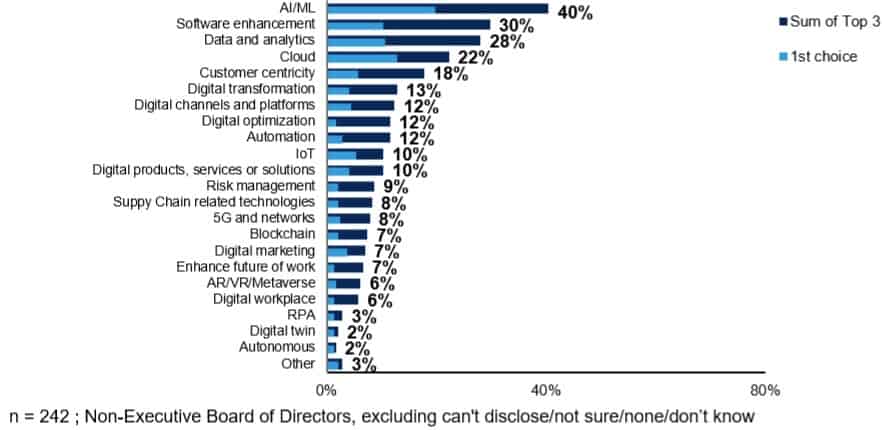
Boards are looking to invest in ‘breakthrough’ technologies that will drive digital business and enterprise success. Forty per cent of board directors consider artificial intelligence (AI) and machine learning technologies to be imperative to digital business success in their organisation, the most-cited response (see Figure 1).
Source: Gartner (October 2022)
Board directors cited software enhancement as their second-highest priority among breakthrough technologies, selected as an area for investment by 30% of respondents.
According to Lopez boards are seeking to modernise and enhance bedrock such as enterprise resource planning (ERP) and customer relationship management (CRM) tools.
“In practice, they are often complex and rigid, when enterprises need agility and change,” he added.
Increased risk appetites
Risk-taking is a key component of digital acceleration. The survey found that 64% of board directors are planning to increase their risk appetite through 2024, climbing seven percentage points from the previous year’s survey findings.
Lopez added that boards recognise that decision-making in a turbulent business environment requires a higher level of risk. “This risk-taking ability is critical to competing at the speed of innovation,” he continued.
Many BoDs are also expanding their vision for digital business success to focus on a ‘digital economic architecture,’ with 71% of board directors reporting that they are pursuing or plan to pursue such an economic structure this year.
Iyengar noted that the evolution from the traditional focus on quarterly returns to a longer-term focus requires a significant change in mindset.
“Boards must recognise and leverage new sources of production and value, which requires a greater ability to accept, and even embrace, risk,” concluded Iyengar.