

Coming into 2026, the Asia-Pacific (APAC) region stands at the forefront of artificial intelligence (AI) adoption, driven by a blend of geopolitical imperatives, technological ambition, and the pressing need for efficient public services.
Governments across APAC are navigating a complex landscape where AI promises to revolutionise citizen interactions but also raises profound questions about sovereignty, ethics, and governance. Drawing from Gartner's 2025 insights, this narrative explores how these trends have evolved, incorporating expert perspectives and real-world developments.
The growing focus on AI sovereignty
A key observable trend among senior technology leaders in government, as highlighted by Dean Lacheca, VP analyst at Gartner, is the emphasis on AI sovereignty.

"With AI, there's such a big focus now on AI sovereignty. But country to country, some countries, they're passionate about it. It's front of mind. Other countries aren't talking about it at all," Lacheca noted in an exclusive interview with FutureCIO.
This disparity reflects the region's diverse political and economic contexts, in which nations like China and India prioritise domestic control over AI models to mitigate foreign influence, while others focus on collaborative frameworks.
In 2025, this sovereignty push manifested in high-level policy statements. Chinese President Xi Jinping, speaking at the APEC summit in November 2025, advocated for global cooperation while underscoring China's vision for AI as a shared benefit.
"Artificial intelligence is of great significance for future development and should be made for the benefit of people in all countries and regions," Xi stated, proposing a World Artificial Intelligence Cooperation Organisation to establish governance rules. This move was seen as a counter to US-led initiatives, aiming to position China as a leader in making AI a "public good."
Similarly, Singapore's Prime Minister Lawrence Wong emphasised AI's transformative potential amid global excitement. In a speech at the G20 Summit in November 2025, Wong urged leaders to "address concerns over AI's impact on jobs and livelihoods and help workers adjust."
He added that the G20 could coordinate efforts to turn AI into "an engine for global growth and for human progress." Wong's comments highlight Singapore's proactive stance, building on its GovTech model, which Lacheca praises as "the epitome of central government agency and development and policy."
In India, Prime Minister Narendra Modi championed localised and ethical AI. At a roundtable with AI start-ups in early 2026 (reflecting 2025 commitments), Modi described them as "co-architects of India's future," stressing that "Indian AI models should promote local and indigenous content and regional languages."
Modi's vision aligns with India's push for ethical, unbiased AI, ensuring it serves diverse linguistic and cultural needs.
Japan's approach, though more measured, echoes these sentiments. Former Prime Minister Fumio Kishida, in earlier statements that influenced 2025 policies, noted: "Generative AI has the potential to be a vital tool to enrich the world further, but we must also confront the dark side of AI."
This caution informed Japan's soft regulatory framework, focusing on innovation with safeguards.
Gartner's top trends shaping 2026
These leadership statements underscore Gartner's top trends for 2025, which continue to shape 2026.
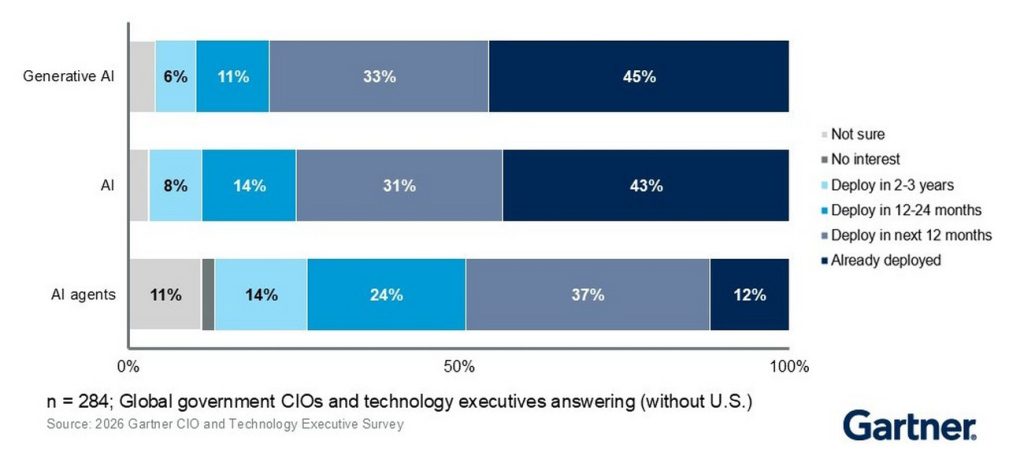
Trend 1: AI agents for tailored citizen services
Lacheca explains: "The use and orchestration of multiple AI agents will expand as the technology matures and governments grow more confident in building, buying, and governing them."
In APAC, deployments include processing applications such as building permits, where transparency is crucial for public trust. For instance, Singapore's innovation labs test AI agents in controlled environments, ensuring ethical guardrails.
Trend 2: Digital innovation labs and data sandboxes
Data restrictions and procurement laws often constrain innovation within government. Examples from 2025 include Singapore's Maritime and Port Authority lab and Taiwan's digital identity wallet sandbox.
Lacheca advises: "Gartner recommends government CIOs build a strong rationale for investments in innovation by validating the essential outcomes that will be delivered from a lab."
These spaces use synthetic data to foster human-centred innovation, protecting privacy while accelerating AI pilots.
Trend 3: Governance-driven AI adoption
Gartner predicts that by 2028, 80% of governments will audit AI independently. "Governments must have oversight over AI technologies to identify and mitigate risks, and ensure alignment with regulatory requirements and governance standards," Lacheca stated in the press release.
In APAC, this ties into sovereignty agendas, with frameworks ensuring transparent, accountable AI.
Persistent challenges: Silos, data and centralisation
However, challenges persist. Governments' decentralised structures hinder knowledge sharing. Lacheca observes: "Governments are large machineries, lots of departments there, that most times move independently of each other."
Siloed decision-making ranks among the top barriers to digital transformation. Efforts like shared platforms aim to reduce duplication, but "every time they put in a shared service, everyone loves to hate on the shared services," Lacheca quips.
Data management is another hurdle. As governments adopt AI, cleaning and centralising data without losing control is essential.
Lacheca notes: "Most governments recognise that data quality and data maturity, especially in unstructured data, are a challenge. And that is going to slow down the government's adoption of that sort of, you know, not all AI, but certain types of AI use cases."
Ethical stewardship, with accountable owners, is key to proving AI's ethical use.
The role of central offices such as OGCIO varies. In Singapore, GovTech succeeds due to "central policy arm and strategy and direction," per Lacheca, enabling consistent execution. Elsewhere, these offices focus on policy rather than delivery and struggle with siloed budgets.
Autonomous operations: Where AI meets human oversight
On the question of autonomous operations in government, Lacheca affirms: "I'm going to say yes. There are plenty of examples where, already in government, they have a level of autonomous capability in service delivery."
For routine tasks like licence renewals, autonomy enhances efficiency, but high-stakes decisions require human oversight for empathy and discretion. AI agents will augment humans, providing insights for consistent, efficient outcomes.
Public sentiment and regional readiness
Public sentiment influences these trends. A 2025 BCG survey revealed APAC leading global AI adoption, with India at 92%, China at high optimism (70%), and Japan at 51%.
The poll, surveying thousands across the region, showed varying attitudes: high enthusiasm in emerging markets, caution in mature ones.
Another poll, the 2025 Edelman Trust Barometer flash poll on AI, highlighted stark contrasts. In China, 87% trust AI, far exceeding Western levels (e.g., 32% in the US). This trust gap underscores APAC's readiness for AI integration, though concerns over jobs and ethics persist.
Looking ahead to 2026 and beyond
Looking to 2026, AI trends in APAC are evolving towards deeper integration. Sovereignty will drive more localised models, as seen in India's focus on indigenous content.
Governance frameworks will mature, with audits ensuring accountability. Innovation labs will expand, fostering the development of AI agents for personalised services.
Yet, overcoming silos and data challenges requires sustained effort. As Lacheca warns, "what's going to make or break it is still going to be people literacy," emphasising workforce upskilling.
In a region of rising expectations and instability, APAC governments are proactively shaping AI's future. By balancing innovation with ethics, they aim to deliver resilient, citizen-focused services that turn AI into a force for inclusive growth.