

Digital overload, the mental exhaustion and productivity drain caused by constant, high-speed digital input, has become a systemic challenge for enterprises.
Leaders and teams are increasingly burned out. Professionals spend more than 11 hours per week searching for information, while much of their time is consumed by “keeping afloat.” In multi-jurisdiction markets where talent is both scarce and expensive, the cost of inefficiency compounds quickly.
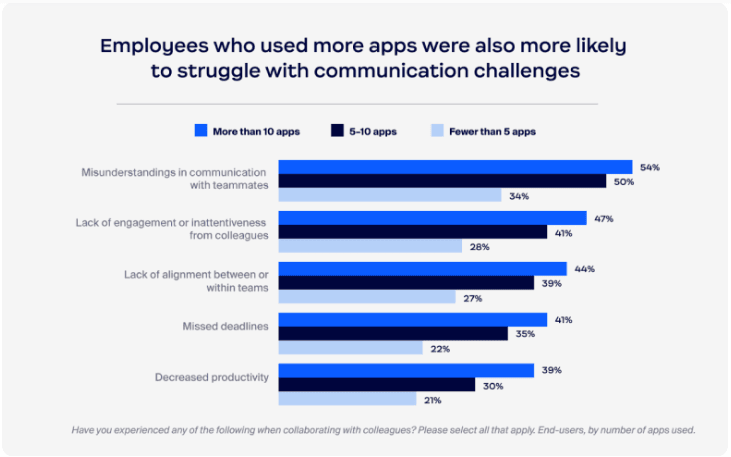
According to Zoom's Global Collaboration in the Workplace report (Jun 2024), using more apps was linked to increased communication problems among employees, often affecting them more than their leaders. Remarkably, more than half (54%) of individuals who utilise over 10 apps reported experiencing misunderstandings in communication. This figure is 20 percentage points higher than the 34% of those who use fewer than five apps.
This is the reality many organisations face today, according to William Smith, head of mid-market Asia & Small Business Sales APAC at Zoom.

“The problem is that as leaders, we become the traffic controllers. We become the glue, the integration layer. And essentially, we are responsible for holding everything together despite all the disparate challenges,” he said. “That’s quite ironic for leaders as well, leading to burnout, and it’s not sustainable.”Speaking at the recent FutureCIO Conference in Thailand, Smith argued that digital overload is not a matter of culture or individual capability, but a structural issue embedded in modern workflows.
“Digital overload is not a cultural issue. It’s not a personal issue. It’s not a laziness issue. It’s a systemic issue,” he said.
The roots of overload
For Smith, too many tools, disconnected systems, and constant interruptions that disrupt attention and slow decision-making drive digital overload.
Scattered information leads employees to spend hours searching for answers. Duplicative tasks waste time. Manual handoffs between teams create friction. Together, these inefficiencies reduce productivity and ultimately impact customer experience.
As digital transformation accelerates, these pressures intensify. “We are quickly entering a time of change. Everything we do is rapidly accelerating,” Smith noted.
In this environment, incremental fixes are no longer sufficient.
From assistive to agentic AI
Assistive AI is like putting a Band-Aid on a wound. It doesn’t actually solve the root cause. William Smith
Smith differentiates between assistive AI and agentic AI. Assistive AI supports users by generating summaries, drafting responses, or surfacing insights. However, it remains passive.
“Assistive AI is like putting a Band-Aid on a wound. It doesn’t actually solve the root cause. It’s a great start, but it is, by definition, passive,” he said.
On the other hand, Agentic AI acts proactively on behalf of users. It can execute tasks, coordinate workflows, and make contextual decisions within defined guardrails, instead of just following prompts.
“The goal is for AI to work on your behalf, not just alongside you,” Smith emphasised.
By embedding intelligence directly into workflows, organisations can reduce coordination overhead and information overload. Teams can now focus on higher-value work and alleviating digital fatigue.
Governance and trust
We’re not here to adopt new things for the sake of tool sprawl. We need measurable outcomes, William Smith
However, Smith cautioned that deploying agentic AI without proper oversight can add another layer of complexity.
For agentic systems to function effectively, they must be observable, contextual, and rational. Leaders must understand how decisions are made, ensure the AI has sufficient context, and confirm that outputs align with business objectives.
“Is the AI correctly observed? Does it understand the context? Can it make a rational judgment?” he urged CIOs to ask.
Governance, he stressed, must be treated as non-negotiable. Moreover, before deploying agentic AI, he advises organisations to establish guardrails, define clear ownership, and determine measurable success criteria.
“We’re not here to adopt new things for the sake of tool sprawl. We need measurable outcomes,” he said.
Start small, scale carefully
Rather than deploying AI initiatives aggressively and at scale, Smith recommends beginning with a single, well-defined workflow, ideally one with a clear owner and measurable pain points.
“Choose one key workflow. Choose something where there’s a clear owner and where you can easily put in guardrails and success criteria,” he advised.
Leaders should define the problem they want to solve, identify the ideal outcome, and assess whether agentic AI can address the gap. Productivity gains, cost control, revenue impact, or improved customer response times are appropriate metrics to define success.
If the pilot delivers tangible, data-backed results, organisations can then scale confidently.
“We don’t want to adopt agentic AI and add complexity, and we also don’t want to adopt it for the sake of it,” Smith said.
A strategic imperative
Ultimately, the case for agentic AI is tied to core leadership priorities: increasing productivity, controlling costs, accelerating growth, and maximising existing assets, particularly in times of uncertainty.
Organisations grappling with digital overload must shift from passive assistance to proactive execution. The key is to maximise agentic AI, meaningfully, reducing friction and complexity.
For Smith, the question is no longer whether digital acceleration will continue, but whether leaders can build systems resilient enough to keep pace without burning people out.