
Technologies like IoT, Cloud, mobile, AI and 5G will all combine to accelerate the global surge in data volume. Today’s data management professionals are already struggling to cope with current technology tools and limited resources.
Whilst volume itself can be managed; the increasing complexity of data is the real kicker. The sprawl of data compounds the complexity of data as higher variety of data comes from more clouds, databases, apps and devices.
To compound the problem, data is becoming more central to anything we do as it is the driver of innovation, consumer experiences operational efficiency and business opportunities.
According to the Veeam Cloud Data Management 2019 report, 34% of organizations are planning to deploy artificial intelligence in the next 12 months. On average they will spend US$41 million each on deploying technologies to build an intelligent business within the next 12 months.
Figure 1: Average spending on AI in 2020
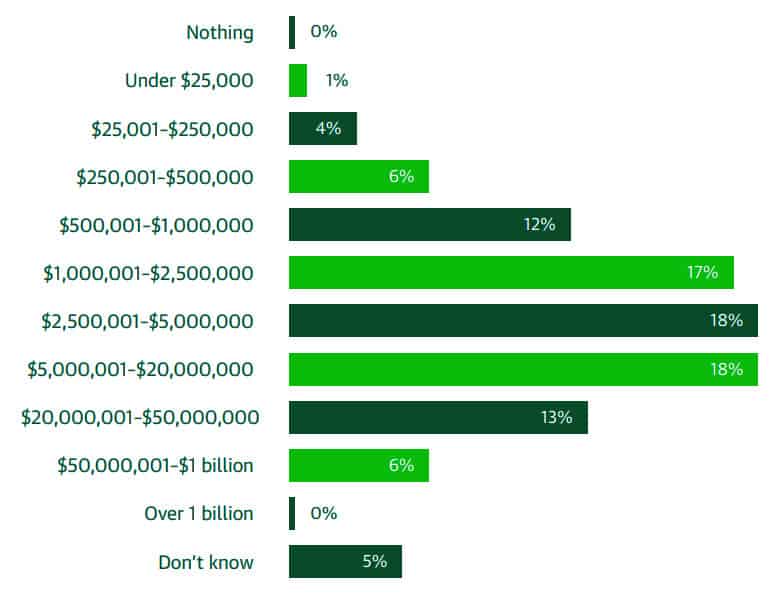
Source: Veeam Cloud Data Management 2019
Overcoming challenges of data growth
We’ve labelled these key challenges: Data Growth, Data Sprawl and Data Criticality. The pressure is on for IT professionals to keep everything running 24/7/365 and AI is the one piece of the puzzle that will help IT professionals by truly automating the back up and management of data.
Traditional policy-based backup doesn’t truly automate tasks, it merely executes set scripts. As such, it does not analyse the merits of each and every situation. This translates into the need for IT professionals to constantly oversee every action.
The set policies also then need to be constantly updated with new rules and for IT professionals to check for policy clashes. The new approach to data management requires data to be “smarter” and self-governing. Data management must evolve from policy-driven to behaviour-driven, with built-in machine learning and artificial intelligence to keep getting smarter about what actions to take.
The problem with traditional backup
Today, data backup is about mechanically copying data at prescribed intervals. But imagine a different world where the system executes a backup in response to what actually happens.
For example, when malware crosses the network, the system takes a backup of the data immediately prior to intrusion.
Or the system sees that the change rate in a particular dataset goes up from 5% to 50% per day, so executes a backup just prior to the change. Or the system notices that a user is suddenly deleting lots of files and executes a backup prior to permanent data loss, alerts the administrator, and sends the backup in for forensic analysis.
AI powered backup has this different approach to the problem. The key advantage of leveraging AI to turn policy-based backup into behaviour-based, will be to help in improving the responsiveness, security and business value of data while reducing the cost and time that humans spend on managing and storing data.
And, most importantly, it will learn how to react automatically to anomalous behaviour in the system.
AI-powered backup
So instead of blindly following scripts, an AI learns to deal with your data to achieve the SLA (service level agreement). A trained AI can actively gather and analyse a task and reallocate resources and adapt to different methods to complete the task within the SLA, which includes smartly moving data to different places when it is threatened.
Over time, self-driving AI backup will understand the environment it is acting in, from resources to performance of these resources. It is therefore able to predict better ways to adapt to new tasks.
This change is significant because it is much “smarter”, but this also changes the job nature of the IT professional. For the most part, an AI powered system doesn’t give notifications until the task is complete.
The IT professional’s role goes from an executor to a manager of the self-driven AI. Instead of being bogged down in execution, IT professionals can work on improving the overall efficiency of the backup and storage system. On top of that, AI can conduct more analysis on more data to help better inform the decisions for the organization of data.
“Innovation” is the only constant in the current world of IT and IT Professionals are in a constant flux of new learnings and technologies which require them to change from mundane to strategic work operations. AI backup will allow the IT administrator to make sound decisions and constantly innovate to improve and intelligently manage the organisation’s data.
5 stages of automated cloud data management
The path to this truly automated cloud data management comes in five stages:
- Stage 1: Backup protects all workloads using backups, complemented by snapshots and replication where appropriate, to ensure they are always recoverable and available in the event of outages, attack, loss or theft.
- Stage 2: Cloud Mobility provides easy portability and fast recovery of ANY on-premises or cloud-based workloads to Amazon AWS, Microsoft Azure and Google Cloud.
- Stage 3: Visibility into the full breadth of your data, accompanied by the infrastructure that it passes through and resides on, so that you that can pivot from reactive to proactive management for better business decisions.
- Stage 4: Orchestration optimizes data utilization across multi-cloud environments with workflows that ensure consistent execution of otherwise manual and complex recovery
- orchestration and data management tasks.
- Stage 5: Automation drives data to become self-managing by learning to protect itself with appropriate SLAs, methods, and locations in order to meet business objectives or comply
- with broader IT initiatives.
Veeam refers to this journey as Cloud Data Management. Whatever you call it, this evolution from tactical data protection to more strategic data management is one of the imperative elements of any Digital Transformation journey.